Last week, I shared how the uterus is not passive — it is responsive, intelligent, and constantly communicating with the rest of the reproductive system. This week, I want to widen the lens once more — because the uterus does not work in isolation. It exists within an ecosystem. And part of that ecosystem is microbial.
We each carry a microbiome — a living community of bacteria, fungi, and other microorganisms — in our gut, on our skin, and importantly, in our reproductive tract. But here is the part we don’t talk about enough:
In couples, these microbiomes interact.
And this shared microbial environment may influence the very earliest steps of conception.

A balanced vaginal microbiome is typically Lactobacillus-dominant, which helps maintain an acidic environment and regulates inflammation and local immunity.
When this balance is disrupted (dysbiosis), inflammation rises — and inflammation is one of the most potent disruptors of implantation and early pregnancy.
This link has been demonstrated in reproductive medicine research examining the vaginal microbiome and fertility outcomes (1).
This is one of the reasons some fertility clinics are beginning to integrate vaginal microbiome testing into treatment planning.
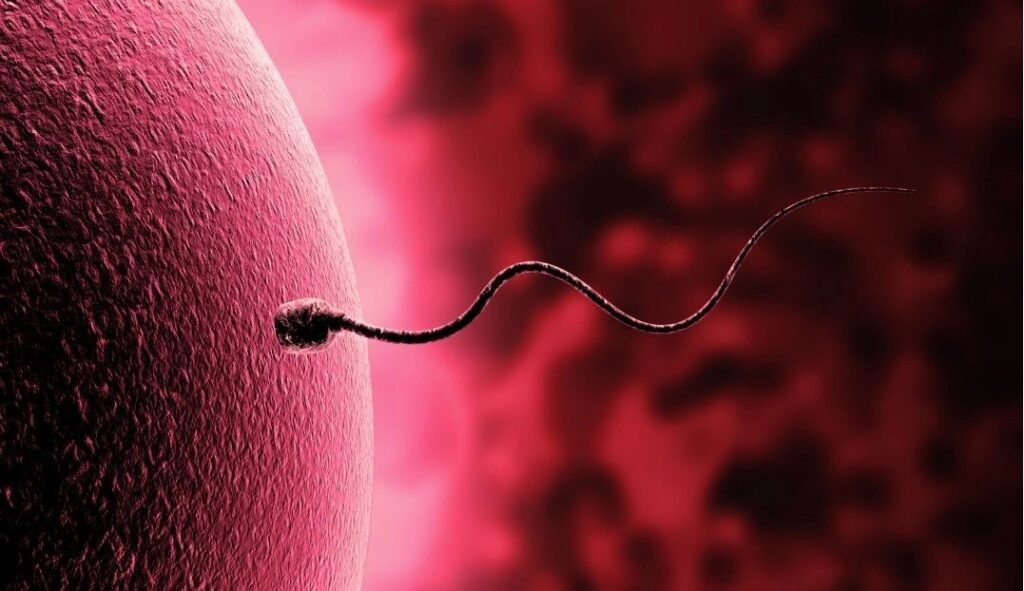
Historically, we evaluated sperm by concentration and motility — almost as isolated cells. But sperm exist within seminal fluid, which contains its own microbiome.
A systematic review and meta-analysis demonstrated that the composition of the seminal microbiome influences:
- Sperm motility
- Oxidative stress
- DNA fragmentation
- Fertilization and embryo development potential
(2)
This means male fertility is not a fixed trait — it is modifiable.
With the proper support, sperm quality can improve.
Here is where the research becomes deeply fascinating.
Studies examining heterosexual couples show that partners frequently share overlapping genital microbiomes, likely through sexual contact and shared environment.
This was demonstrated in a well-designed couple-based microbiome study (5).
Research involving couples undergoing IVF has also found that microbial patterns in each partner may be linked with their fertility outcomes (6).
Additionally, studies describing sexual microbiome exchange suggest the process is dynamic and ongoing, not random (4).
And a recent analysis of infertile couples found that examining both partners together reveals patterns not visible when each is evaluated separately (3).
In other words:
Fertility may not be an individual physiological state — but a shared biological environment.
This aligns with what I observe clinically: fertility outcomes improve most consistently when both partners participate in health optimization, even when only one partner has the “diagnosis.”
These gentle, evidence-aligned strategies support a healthy shared reproductive microbiome:
- Increase plant diversity in meals.
Different plants feed different beneficial microbes.
Aim for ~30 plant types per week. - Use probiotics intentionally, not casually.
Choose strains with evidence for urogenital health (I will write more on this soon). - Avoid antibacterial genital washes and scented products
They disrupt the natural protective microbiome.
Water is enough. - Support stress recovery
The microbiome responds directly to cortisol’s rhythm —not just the quantity of stress. - Protect sleep as a hormonal and reproductive organ regulator
Ovaries and testes both rely on sleep architecture.
Small, steady steps make a meaningful difference.

This emerging research reinforces a truth I have seen repeatedly in practice:
Fertility is not solely cellular, hormonal, or genetic.
It is relational — physiologically, emotionally, and biologically.
Your body does not conceive alone.
It conceives with another body.
And those two bodies are in conversation — right down to the microscopic level.
This is not only scientific — it is profoundly hopeful.
- Günther, Veronika, et al. “Vaginal Microbiome in Reproductive Medicine.” Diagnostics 12, no. 8 (2022): 1948. https://doi.org/10.3390/diagnostics12081948.
- Farahani, Linda, et al. “The Semen Microbiome and Its Impact on Sperm Function and Male Fertility: A Systematic Review and Meta-analysis.” Andrology 9, no. 1 (2021): 115–144. https://doi.org/10.1111/andr.12886.
- Baud, David, et al. “Genital Microbiota in Infertile Couples.” Reproductive BioMedicine Online 51, no. 5 (2025): 105056. https://doi.org/10.1016/j.rbmo.2025.105056.
- Ma, Zhanshan S. “Microbiome Transmission During Sexual Intercourse Appears Stochastic.” Frontiers in Microbiology 12 (2022): 789983. https://doi.org/10.3389/fmicb.2021.789983.
- Mändar, Reet, et al. “Complementary Seminovaginal Microbiome in Couples.” Research in Microbiology 166, no. 5 (2015): 440–447. https://doi.org/10.1016/j.resmic.2015.03.009.
- Okwelogu, Somadina I., et al. “Microbiome Compositions from Infertile Couples Seeking IVF.” Frontiers in Cellular and Infection Microbiology 11 (2021): 709372. https://doi.org/10.3389/fcimb.2021.709372.
Dr Marina OBGYN