Artificial intelligence (AI) is rapidly changing medicine. From radiology to oncology, AI is helping physicians analyze complex information more efficiently and accurately. Fertility care is no exception. While much of the current attention has focused on AI in IVF laboratories, I believe one of the most exciting opportunities lies elsewhere: helping more couples conceive naturally.
As a physician who has spent more than 35 years helping patients build their families, I have watched fertility care evolve from basic hormone testing to sophisticated genetic and metabolic assessments. The next frontier may be the use of AI to identify fertility challenges earlier, personalize recommendations, and help patients optimize their reproductive health before infertility develops.¹
Fertility Is a Data Problem
Every day, our bodies generate enormous amounts of information. Menstrual cycles, sleep patterns, exercise habits, nutrition, stress levels, hormone fluctuations, wearable device data, laboratory results, and environmental exposures all contain clues about fertility.
The challenge is not collecting the data—it is making sense of it.
Artificial intelligence excels at finding patterns in large and complex datasets. Researchers have suggested that AI is ideally suited to reproductive medicine because fertility involves multiple interacting biological, lifestyle, and environmental factors that change over time.¹
In the future, AI may help clinicians identify subtle fertility risks years before they become clinically apparent.
Smarter Fertility Tracking
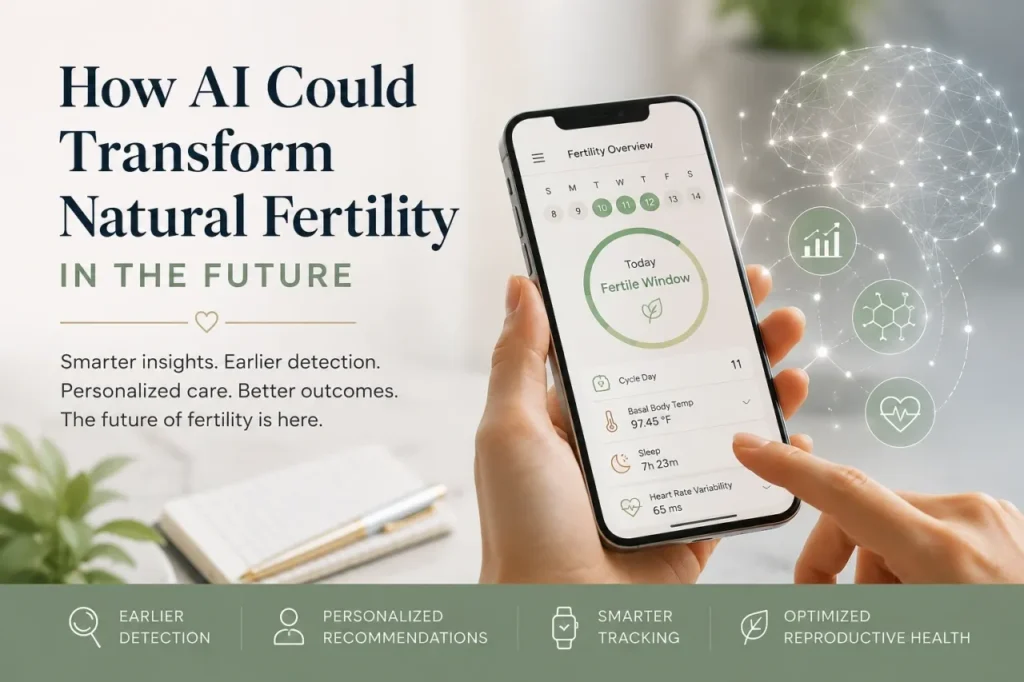
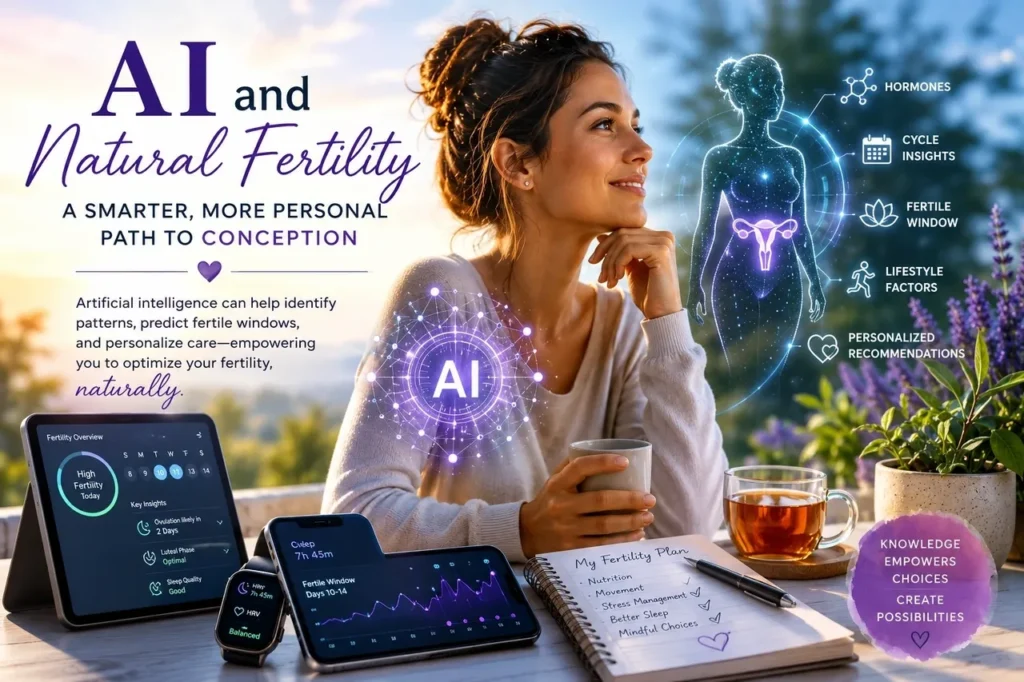
Many women already use fertility tracking apps, but most rely heavily on calendar calculations. The next generation of AI-powered systems will likely be far more sophisticated.
Recent studies have shown that machine-learning algorithms can identify menstrual cycle phases and predict fertile windows using physiological information collected from wearable devices such as heart rate monitors and temperature sensors.²⁻⁴
Researchers have demonstrated that machine-learning models can identify menstrual cycle phases using skin temperature, heart rate, and other physiological signals collected from wrist-worn devices without requiring users to manually enter data.²
Similarly, Luo and colleagues showed that machine-learning algorithms could predict fertile windows using wearable temperature and heart rate measurements, potentially making fertility awareness methods more accurate and accessible.³
These technologies may eventually allow women to receive personalized fertility predictions based on real-time biological information rather than population averages.
Earlier Detection of Fertility Problems
One of the most promising applications of AI is the early identification of reproductive health issues.
Imagine a woman in her twenties using a wearable device that continuously tracks sleep, heart rate variability, physical activity, temperature, and menstrual cycle characteristics. AI could potentially identify patterns suggestive of polycystic ovarian syndrome, endometriosis, diminished ovarian reserve, thyroid dysfunction, insulin resistance, or other conditions before fertility problems arise.
Rather than reacting to infertility after months or years of unsuccessful attempts at conception, future fertility care may become increasingly preventive.
Personalized Fertility Recommendations
I often tell my patients that there is no single fertility diet, supplement, or lifestyle program that works for everyone.
Future AI systems may help determine which interventions are most likely to benefit a particular individual.
Researchers have proposed that AI could integrate hormonal data, metabolic markers, genetic information, lifestyle habits, environmental exposures, and reproductive history to generate highly personalized recommendations.¹
For one woman, the greatest benefit may come from improving sleep. For another, reducing insulin resistance may be more important. For someone else, addressing environmental toxin exposure may provide the greatest opportunity for improvement.
This is precision medicine applied to fertility.
AI and Male Fertility
Male fertility contributes to approximately half of infertility cases, yet it remains underappreciated and underinvestigated.
AI has already demonstrated impressive capabilities in analyzing sperm characteristics and identifying patterns associated with male reproductive health. Researchers are developing systems capable of integrating semen parameters, hormonal profiles, lifestyle factors, and environmental exposures to predict fertility potential more accurately than traditional approaches alone.¹
In the future, AI may help identify men at risk for declining sperm quality long before they present with infertility.
The Role of Wearable Technology
Wearable devices are becoming increasingly sophisticated.
Studies have shown that wearable physiological monitoring can improve fertile-window prediction compared with traditional calendar-based methods.⁴⁻⁶ Researchers are also investigating how heart rate variability, temperature patterns, sleep quality, glucose regulation, and other biomarkers may provide insights into reproductive health.²⁻⁶
As these technologies improve, fertility monitoring may become more continuous, individualized, and proactive.
The Human Side of Fertility
Despite the excitement surrounding AI, there is something important to remember.
Pregnancy is not merely a biological event.
It is deeply emotional, personal, and human.
Artificial intelligence can analyze data. It can identify patterns. It can generate predictions. But it cannot replace empathy, clinical judgment, or the physician-patient relationship.
The most effective future will likely combine the strengths of both worlds: sophisticated AI tools supported by knowledgeable healthcare professionals who understand the unique circumstances of each patient.
Looking Ahead
I often remind my patients that fertility is a vital sign of overall health.
The greatest promise of artificial intelligence may not be helping people undergo more fertility treatments. Instead, it may be helping us identify risks earlier, optimize health sooner, and prevent infertility whenever possible.
For decades, fertility medicine has focused primarily on treatment. Artificial intelligence offers the possibility of shifting our attention toward prediction, prevention, and personalization.
If used thoughtfully, AI may help more couples achieve what they desire most: a healthy pregnancy and a healthy baby.
After all, when we improve health, fertility often follows.
References
- Hanassab, Simon, Ali Abbara, Arthur C. Yeung, et al. “The Prospect of Artificial Intelligence to Personalize Assisted Reproductive Technology.” NPJ Digital Medicine 7, no. 55 (2024). https://doi.org/10.1038/s41746-024-01006-x.
- Kilungeja, Grentina, Krystal Graham, Xudong Liu, and Mona Nasseri. “Machine Learning-Based Menstrual Phase Identification Using Wearable Physiological Signals.” NPJ Women’s Health (2025).
- Luo, C., et al. “Prediction of the Fertile Window and Menstruation with a Machine-Learning Algorithm Based on Wearable Temperature and Heart Rate Data.” Reproductive BioMedicine Online (2025).
- Yu, J. L., et al. “Tracking of Menstrual Cycles and Prediction of the Fertile Window Using Basal Body Temperature and Heart Rate.” Journal of Assisted Reproduction and Genetics 39 (2022): 1443–1455.
- Shi, Y., et al. “The Diagnostic Accuracy of Wearable Digital Technology in Fertility Window Detection.” NPJ Digital Medicine (2026).
- Thigpen, N., et al. “Oura Ring as a Tool for Ovulation Detection.” Journal of Medical Internet Research 27 (2025): e60667.
Dr Marina OBGYN