
A recent article by Yola Robert published in Forbes on March 25, 2026 has generated significant excitement. It highlights a case study describing successful pregnancies in women aged 45 and 47 using their own eggs—something many people have long believed to be nearly impossible.
As an obstetrician-gynecologist who has spent more than three decades caring for women and walking alongside them through fertility challenges, I welcome any development that brings hope. But I also believe we have a responsibility—especially as physicians and educators—to interpret these findings thoughtfully and place them in proper context.
Because hope is powerful.
And so is biology.
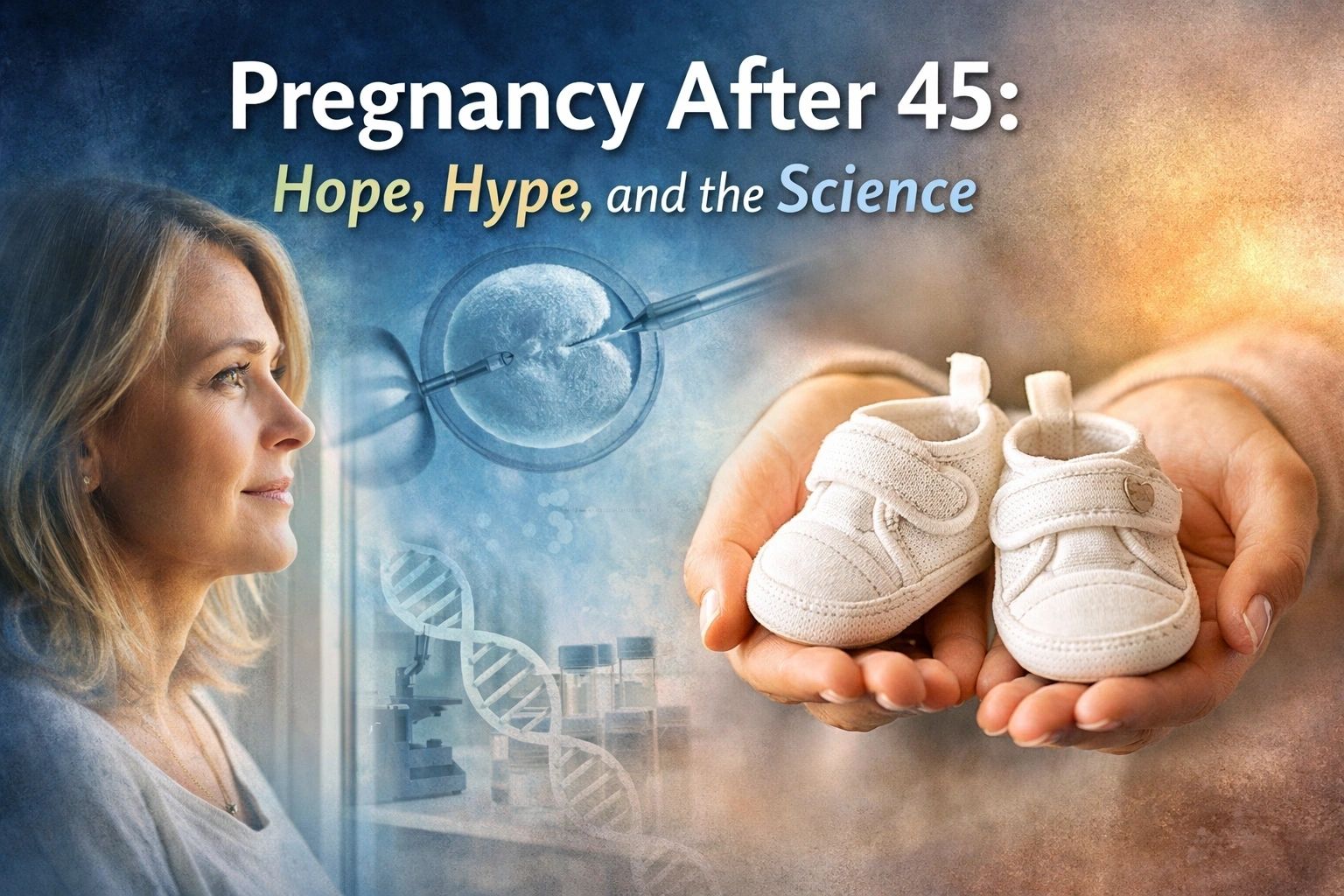
The report described two healthy live births in women over age 45, achieved through advanced reproductive techniques.
This is important. It demonstrates possibility. It pushes the boundaries of what medicine can achieve.
But it is also critical to remember that this was a case study, not a large clinical trial.
Case studies are valuable signals.
They are not predictions.
Historically, natural conception rates decline significantly with age. For example, estimates suggest that the chance of natural conception drops to about 5% by age 40 and approaches 1% after age 45.
These numbers matter—not to discourage women, but to empower them with realistic expectations and informed decision-making.
We are living in a time when women are delaying pregnancy for many understandable reasons:
- Education
- Career development
- Financial stability
- Finding the right partner
- Caring for aging parents
- Simply not realizing fertility declines earlier than expected
This is something I see every day in my clinical practice, and it is one of the central themes in my book and speaking work.
The modern fertility landscape has changed—but human biology has not changed as quickly as our social structures.
And that gap is where many women experience confusion, frustration, and sometimes heartbreak.
One of the most important lessons from this case study is not that pregnancy after 45 is common.
It is that fertility is not an on-off switch.
It is a spectrum.
Even in women in their mid-to-late forties:
- Pregnancy is less likely
- Miscarriage risk is higher
- Chromosomal abnormalities are more common
- But pregnancy is still possible
Medicine is increasingly helping us stretch the limits of reproductive potential—but it cannot completely override the natural aging of eggs.
What excites me most about this case study is not the individual pregnancies themselves.
It is what they represent.
We are entering a new era in reproductive medicine that includes:
- Regenerative and cellular therapies
- Improved ovarian stimulation protocols
- Better embryo selection technologies
- Personalized reproductive care
- A growing understanding of lifestyle and environmental influences
This aligns closely with what I have been teaching for years:
fertility is a marker of overall health.
When we optimize health, we often optimize fertility.
Headlines can sometimes create unintended consequences.
A story like this may lead some women to believe:
“I have plenty of time.”
But the truth is more nuanced.
Yes—pregnancy after 45 is possible.
No—it is not predictable.
And it is rarely easy.
The danger is not hope.
The danger is false reassurance.
Here is the message I share with my patients and audiences:
Do not take your fertility for granted.
Instead:
- Learn about your fertility early
- Understand your ovarian reserve
- Protect your metabolic and hormonal health
- Reduce exposure to endocrine disruptors
- Optimize sleep, nutrition, and stress management
- Seek guidance sooner rather than later
These steps cannot stop the biological clock—but they can help you make the most of the time you have.
This case study also raises an important public health question.
If women are increasingly delaying pregnancy, we must ensure they have:
- Accurate fertility education
- Access to reproductive care
- Workplace policies that support family planning
- Honest conversations about age and fertility
The global fertility decline is not just a medical issue.
It is a societal one.
And solutions will require collaboration across medicine, education, policy, and culture.

After more than 30 years in women’s health, I have learned this:
Fertility is resilient.
But it is not limitless.
This new research offers hope—and hope is essential.
But the most powerful message remains prevention and preparation.
Because the earlier we protect fertility,
the more options women have later.
And that is the future I want for the next generation of women.
1. Robert, Yola.
“New Medical Case Study Suggests Promising Fertility Outcomes for Women Over 45.” Forbes, March 25, 2026.
2. Merhi, Zaher, Bhavika Garg, and Jessica Haroun.
“First Live Births After Adipose-Derived Stem Cells and Platelet-Rich Plasma Intraovarian Administration.” American Journal of Stem Cells 14, no. 5 (2025): 277–283. https://doi.org/10.62347/KWFR2442.
3. American College of Obstetricians and Gynecologists.
“Female Age-Related Fertility Decline.” ACOG Committee Opinion No. 589. Washington, DC: American College of Obstetricians and Gynecologists, 2014. Reaffirmed 2021.
Dr Marina OBGYN