

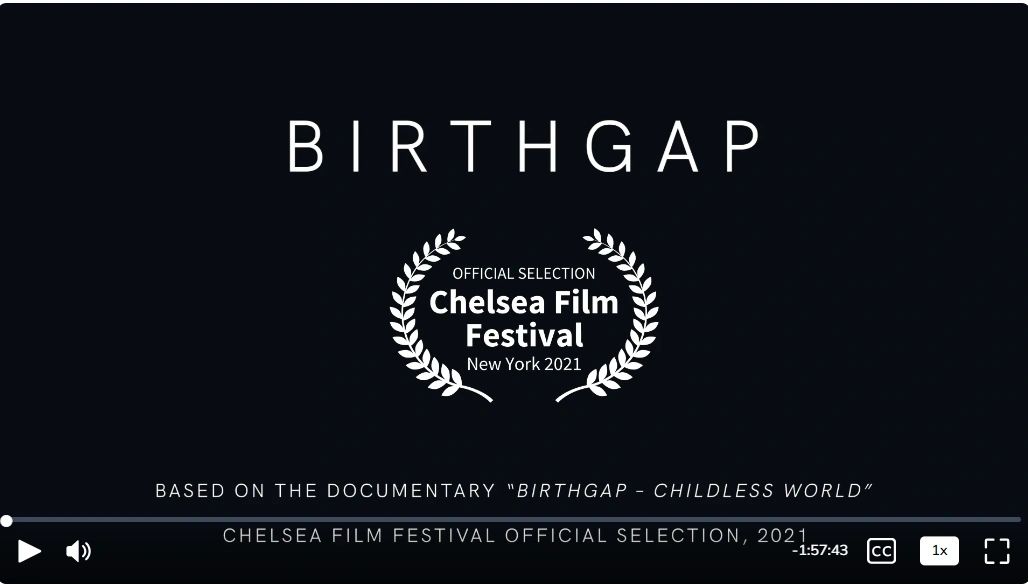
The documentary Birthgap, by Stephen J. Shaw, shines a harsh but necessary light on a reality few want to acknowledge: the vast majority of women who end up childless did not choose that path. In fact, research highlighted in the film shows that over 90% of childless women had actually wanted children (1). Their lives were not a rejection of motherhood but instead shaped by circumstances—delayed partnerships, infertility, economic insecurity, or simply not knowing how narrow the biological window for fertility really is.
This is not a matter of individual failure; it’s a collective blind spot. Society talks a great deal about avoiding teen pregnancy but rarely offers young people accurate, science-based education about the limits of fertility with age. The result? Women (and men) often find out too late that their reproductive years are not as flexible as they had believed (2).
One of the most moving points of Birthgap is the generational gap in understanding fertility. Many young people today grow up hearing about reproductive technologies like IVF and egg freezing, assuming they can delay childbearing almost indefinitely. Yet even with the best science, success rates fall sharply with age, and treatments are neither guaranteed nor affordable for all (3).
At the same time, many people still cling to the idea that overpopulation is the great global challenge. This was a dominant narrative in the 1970s and continues to echo today. But the reality is that a fertility crisis is quietly unfolding in many countries, where birth rates have plummeted below replacement levels (4). Without a shift in understanding, entire societies may face shrinking populations, labor shortages, and intergenerational imbalance.
If more than 90% of women who are childless actually wanted children, then the solution is not just more clinics, more treatments, or more government incentives. The solution starts with knowledge. Fertility education should be as fundamental in high school health curricula as lessons on nutrition, exercise, or contraception.
Young people deserve to know:
- The biological limits of egg and sperm quality (5).
- The real success rates of IVF and egg freezing at different ages (6).
- The impact of lifestyle, environment, and health on reproductive potential (7).
- The demographic reality that societies with declining birthrates face (8).
This isn’t about pressuring teenagers to start families early. It’s about empowering them to make informed life choices so that they are not blindsided in their late thirties or forties.

Birthgap is more than a documentary—it is a wake-up call. If we want to prevent a future where regret dominates the lives of millions, we must act now. Fertility is a vital sign of health and longevity, and understanding it should not be reserved for medical students or those already struggling with infertility.
By bringing fertility education into high school classrooms, we give the next generation the tools they need to align their life goals with their biological reality. Knowledge doesn’t take away choice; it expands it. And perhaps, if we listen to the lessons of Birthgap, fewer women will have to look back on their lives and wonder why no one told them sooner.
I found the documentary both very informative and thought-provoking, and I strongly recommend watching it (1). It opens the door to conversations we desperately need to have—not only about fertility, but also about dispelling the outdated fear of overpopulation and recognizing the demographic challenges ahead.
- Shaw, Stephen J. Birthgap: Childless World. Documentary film. 2023.
- Mills, Melinda, et al. “Why Do People Postpone Parenthood? Reasons and Social Policy Incentives.” Human Reproduction Update 17, no. 6 (2011): 848–860. https://doi.org/10.1093/humupd/dmr026.
- Centers for Disease Control and Prevention (CDC). “2019 Assisted Reproductive Technology Fertility Clinic and National Summary Report.” Atlanta: U.S. Department of Health and Human Services, 2021.
- United Nations, Department of Economic and Social Affairs. World Population Prospects 2024: Summary of Results. New York: UN, 2024.
- Broekmans, Frank J., et al. “Female Reproductive Ageing: Current Knowledge and Future Trends.” Trends in Endocrinology and Metabolism 18, no. 2 (2007): 58–65. https://doi.org/10.1016/j.tem.2007.01.004.
- Goldman, Rachel H., et al. “Predicting the Likelihood of Live Birth for Elective Oocyte Cryopreservation: A Counseling Tool for Physicians and Patients.” Human Reproduction 32, no. 4 (2017): 853–859. https://doi.org/10.1093/humrep/dex008.
- Chavarro, Jorge E., Walter C. Willett, and Patrick J. Sluss. “Lifestyle and Fertility: The Role of Nutrition, Exercise, and Environment.” Seminars in Reproductive Medicine 30, no. 2 (2012): 131–145.
- Organisation for Economic Co-operation and Development (OECD). Society at a Glance 2024: OECD Social Indicators. Paris: OECD Publishing, 2024.
Dr Marina OBGYN