
Every year on International Women’s Day, we celebrate the remarkable achievements of women. Over the past century, women have entered professions once closed to them, advanced in science and medicine, led companies and governments, and reshaped our societies in profound ways. These accomplishments are worth celebrating.
But alongside these gains, another story is unfolding more quietly—one that deserves our attention.
It is the story of fertility.
Recently, columns in The Globe and Mail have highlighted Canada’s continuing decline in birth rates. In particular, columnist Robyn Urback discussed how social and economic pressures are leading many young Canadians to delay or forgo parenthood altogether.¹
Canada’s fertility rate has now fallen to approximately 1.25 children per woman, far below the replacement rate of 2.1 needed to maintain population stability without immigration.²
Urback points to several reasons young adults are postponing parenthood:
- rising housing costs
- financial insecurity
- expensive childcare
- career pressures
- shifting cultural expectations about when people should start families
These are real pressures, and they cannot be ignored.
But as a physician who has spent more than thirty years caring for women and couples hoping to conceive, I believe another critical part of this conversation is often missing.
That missing piece is biology.
One of the great triumphs of modern society is that women now have the freedom to pursue education, careers, travel, and personal growth in ways that were unimaginable to earlier generations.
Yet biology has not evolved nearly as quickly as our social structures.
Human fertility still follows the same biological timeline it always has. Egg number and quality begin to decline gradually in the early thirties and more rapidly after age thirty-five. By the early forties, natural conception becomes significantly more difficult for many women.³
Unfortunately, many women are simply not told this early enough.
Too often, the message women receive is that reproductive technologies can reliably solve the problem later. While assisted reproductive technologies such as IVF can be incredibly helpful, they cannot fully overcome the biological effects of age. Success rates decline substantially as maternal age increases.⁴
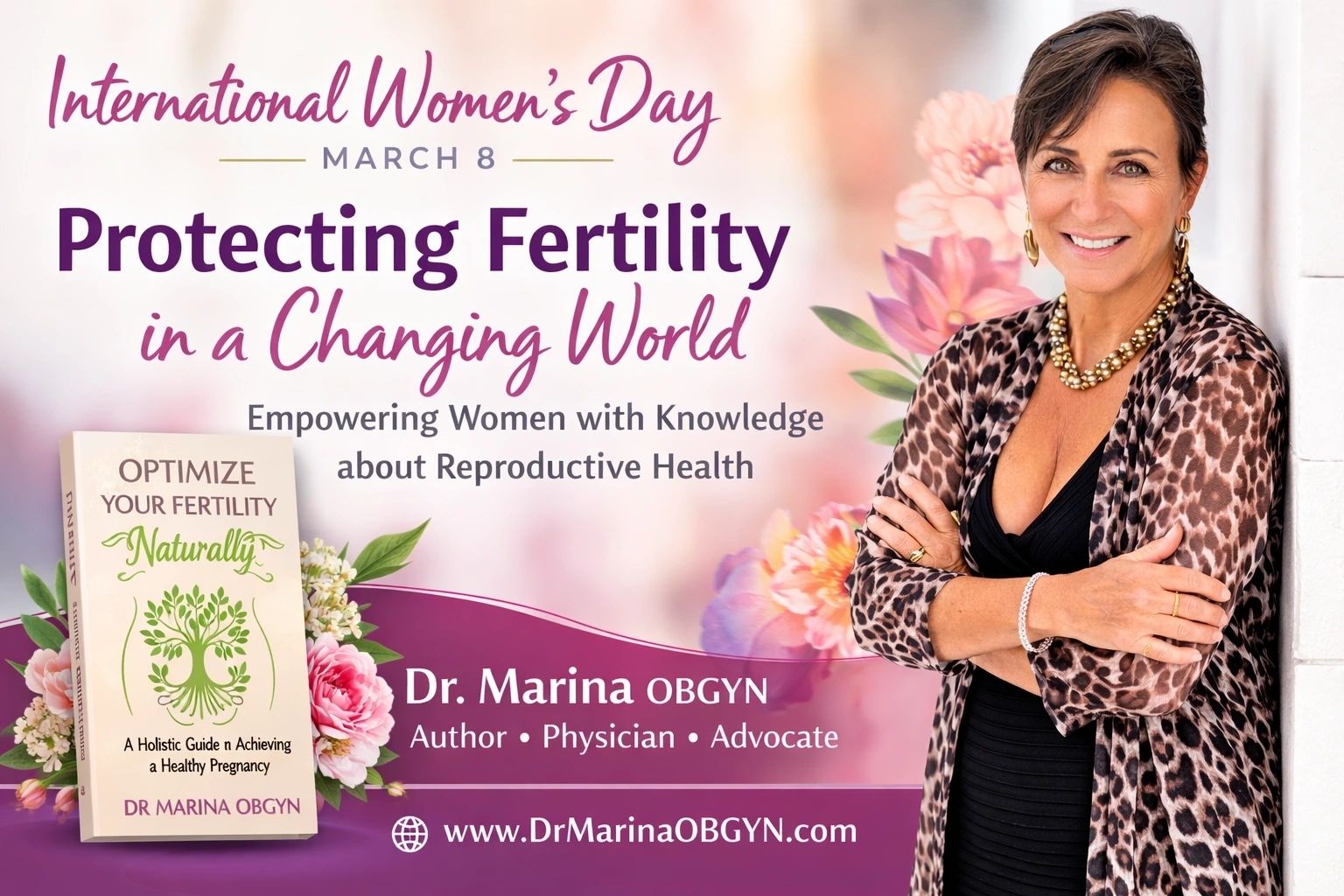
This is one of the central messages in my book, Optimize Your Fertility Naturally, a holistic guide designed to help women understand and protect their reproductive health long before fertility problems arise.
My goal in writing the book was simple: to give women the information I wish more of my patients had received earlier in life.
When we fail to talk openly about fertility, women pay the price.
Many women reach their mid-to-late thirties assuming they still have plenty of time, only to discover that their reproductive options are already narrowing.
Others experience infertility that might have been mitigated through earlier awareness of:
- metabolic health
- environmental exposures
- lifestyle habits
- reproductive timing
This conversation is not about placing pressure on women to have children earlier.
It is about providing accurate biological information, so women can make decisions that align with their own values, careers, and life goals.
True empowerment comes from knowledge.
Fertility is not simply about age or timing. It is deeply connected to overall health.
Metabolic health, nutrition, sleep quality, environmental toxins, endocrine disruptors, and chronic inflammation all influence reproductive potential. Conditions such as insulin resistance and polycystic ovarian syndrome—both increasingly common—are reshaping the fertility landscape for many young women.⁵
One of the most consistent observations in clinical practice is this:
When we improve health, fertility often improves as well.
That is why my approach to fertility has always been rooted not only in reproductive medicine, but also in preventive health.
The body reflects how it is lived in.
International Women’s Day is about expanding opportunities for women.
But true opportunity also requires accurate health education.
Women deserve to know:
- how fertility changes with age
- how lifestyle influences reproductive health
- what reproductive technologies can and cannot do
- and how to protect fertility if motherhood may be part of their future
Fertility should never be taken for granted.
When women understand their biology earlier, they gain the freedom to plan their lives more intentionally—whether that includes children, career ambitions, or both.
The decline in birth rates we are seeing today is not simply a demographic statistic.
It reflects millions of personal decisions shaped by economic pressures, cultural expectations, and biological realities.
But one thing is clear:
Awareness matters.
If we want women to truly have choices about their reproductive futures, we must start talking about fertility earlier, more openly, and with better education.
On this International Women’s Day, let us celebrate women’s achievements while also ensuring that women have the knowledge they need to protect one of their most fundamental biological capacities.
Because empowered women deserve empowered choices.
References:
- Robyn Urback, column discussing declining fertility and social pressures affecting family formation, The Globe and Mail, 2026.
- Statistics Canada. “Births and Fertility Rates in Canada.” Ottawa: Statistics Canada, 2024.
- American College of Obstetricians and Gynecologists. “Female Age-Related Fertility Decline.” Obstetrics & Gynecology 123 (2014): 719–721.
- Centers for Disease Control and Prevention. Assisted Reproductive Technology Fertility Clinic Success Rates Report. Atlanta: CDC, 2023.
- Helena J. Teede, Michael L. Misso, Michael F. Costello, Andrea Dokras, Joop Laven, Lisa Moran, et al. “Recommendations from the International Evidence-Based Guideline for the Assessment and Management of Polycystic Ovary Syndrome.” Human Reproduction 33, no. 9 (2018): 1602–1618.
Dr Marina OBGYN